











A global divide has emerged between mid-market company leaders confidently investing in digital transformation and new jobs to exploit expansion opportunities – and businesses eyeing the future more cautiously amid concerns over costs, geopolitical impact on supply chains and sluggish economic growth.
South Africa has the most optimistic outlook among mid-market businesses in 17 international markets polled for the latest Moore Thrive Index. It is closely followed by Saudi Arabia and the United Arab Emirates, while companies based in Europe, where economies are generally under pressure, are the most cautious on this year’s prospects.
The survey of 2,425 business leaders compared performance over the last year and expectations for the year ahead, collating responses across five key measures: overall business performance, revenue, costs, labour markets and investment.
Cost pressure is a common theme, impacting not just business performance last year but also weighing on the outlook for this year, particularly regarding energy, fuel and logistics as well as rising wage bills.
On a global view, businesses remain broadly positive about the outlook and are investing in solutions and talent to boost resilience and competitiveness in a more volatile trading environment.
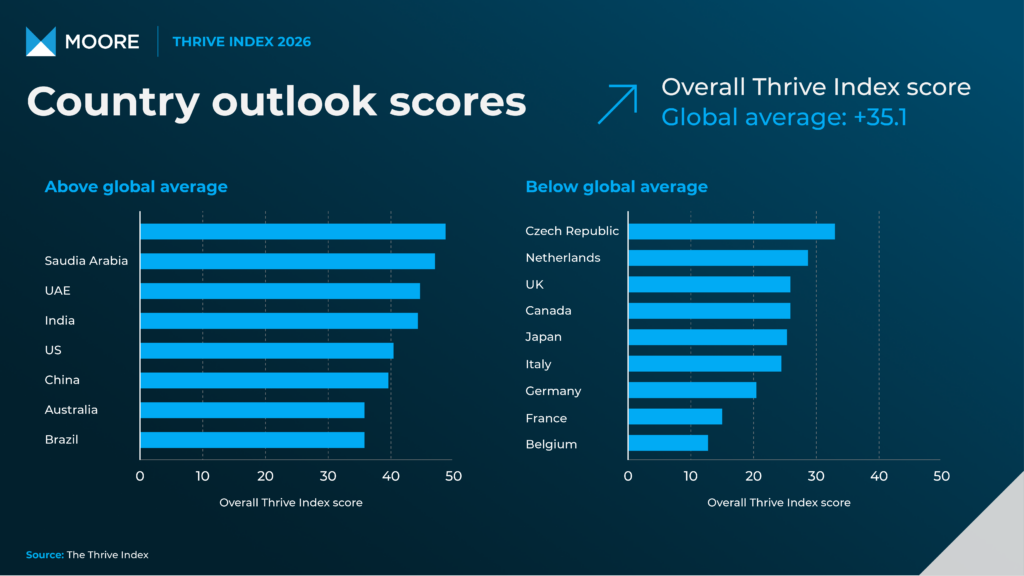
Companies in almost half of the countries surveyed recorded overall Index scores above the global average of +35.1: including: South Africa, Saudi Arabia, the United Arab Emirates, India, the United States, China, Australia and Brazil.
The Americas
Index Score for United States +40.6 … +5.5 v Global Average
Index Score for Canada +26.0 … -9.1 v Global Average
Index Score for Brazil +36.8 … +1.7 v Global Average
The United States outperformed the global average across most indicators, although its Thrive Index score was broadly similar to last year. However, the US recorded substantially more negative scores on costs than other countries, due to the impact of persistent wage pressures, elevated financing costs and tariff-related increases in input prices.
Across the border in Canada, the Index score was much lower than the average, not helped by the slowest pace of GDP growth last year since the Covid period. Less than half of Canadian businesses expect to add headcount and business performance expectations for the next 12 months are subdued.
Meanwhile in Brazil, regarded as one of the big potential economic winners in years to come, performance was mixed. It has a higher score than this year’s global average but there is a marked decline from last year. However, there are high hopes for the coming year underpinned by digital transformation efforts and improvements in operational efficiency.
Asia & Australia
Index Score for China +39.5 … +4.4 v Global Average
Index Score for India +44.1 … +9.0 v Global Average
Index Score for Japan +25.6 … -9.5 v Global Average
Index Score for Australia +36.9 … +1.8 v Global Average
China displays greater optimism for the year ahead than most other countries. The key drivers behind the expectations of improved future business performance include increased demand across key markets and expansion into new geographies. On balance, Chinese businesses have experienced a rise in costs over the past year but it is raw material costs rather than wages or energy that firms worry most about.
It was a similar story of outperforming the global average in India, which scored above average on most measures of confidence. Almost 90% of firms reported an improvement on performance last year, while investment was more resilient than in other countries and spread across a wide range of areas.
Meanwhile Japan, saw its year-on-year score improve significantly but it still lags other major economies. Labour costs were cited more frequently as a key reason for rising costs while the country remains exposed to external shocks through its reliance on imported energy.
Australia also saw a big jump in its score from 2024, thanks to broader improvements in macroeconomic conditions. GDP growth doubled last year, there was a rebound in domestic demand and inflation moved closer to target.
Europe
Index Score for Czech Republic +32.6 … -2.5 v Global Average
Index Score for Netherlands +28.8 … -6.3 v Global Average
Index Score for UK +26.2 … – 8.9 v Global Average
Index Score for Italy +24.4 … -10.7 v Global Average
Index Score for Germany +20.3 … -14.8 v Global Average
Index Score for France +15.2 … -19.9 v Global Average
Index Score for Belgium +12.0 … -23.1 v Global Average
Companies in the Czech Republic are the most upbeat among European nations, posting a marked improvement versus the 2024 score, although the total Index score was still slightly below the global average. Companies report supply chain improvements and enhanced operational efficiency as top factors driving better business performance. Looking ahead, more than half identify a challenging labour market as a concern.
The Netherlands also scored higher in 2025 than in 2024, aligned with an improvement in domestic economic growth to 1.9% last year from 1.1%. However, worries over persistent inflationary pressure, wage demands and a tight labour market, are causing companies to rein back on investment spending and expansion plans in the current year.
Elevated staffing costs played a significant role in the UK recording a relatively low total score, 14.3 points down on its 2025 score and below the global average. Companies report ongoing concerns over inflation as well as high costs for wages, energy and other essential inputs. Despite this, they remain broadly confident on the outlook for overall business performance this year, with the UK ahead of the global average on revenue expectations.
Companies in Italy are maintaining investment despite a difficult backdrop of subdued demand. This impacted revenue in 2025 and is expected to curtail revenue growth this year, although company leaders remain broadly positive on expectations for overall business performance in 2026. Businesses are cutting back on staff costs, with a sharp deterioration in hiring expectations.
In Germany, higher energy prices, raw material and employment costs led to significant cost pressures, with 63% of firms experiencing higher costs. Despite near stagnant growth in Europe’s largest economy, the overall score for Germany showed a slight improvement over last year. It still trails the global average, and the outlook is positive but cautious, clouded by uncertainty over geopolitical events and the potential for further energy price shocks.
Business leaders in France are generally more cautious on investment spending, impacted by concern over the possibility of higher borrowing costs. However, sentiment may shift as recent data indicate that French inflation has retreated from a two-year high. On a positive note, France is more insulated from rising global energy costs than other industrial nations as the nuclear sector provides around 70% of the country’s needs. The total Index score of +15.2 was among the lowest of the 17, impacted by muted expectations for revenue and overall performance this year.
In Belgium,companiesare particularly cautious on the labour market, with 46% planning to reduce headcount this year. Belgium also diverged from the broader global trend on investment intentions, signalling plans to decrease investment spending. Belgian companies had the lowest overall Index score, reflecting the constraints of operating in a country with slow growth and high public debt. However, on balance they remain broadly optimistic on the outlook for revenue and business performance.
Middle East & Africa
Index Score for South Africa +47.6 … +12.5 v Global Average
Index Score for Saudi Arabia +46.2 … +11.1 v Global Average
Index Score for UAE +44.5 … +9.4 v Global Average
South Africa topped the league table of 17 countries, reporting strong overall business performance for the past year and confidence in the year ahead. Companies are bullish on planned investment and the labour market and confident that digital transformation benefits and productivity gains will deliver a strong performance again this year. Confidence is supported by progress on widespread national structural reform and recent evidence of acceleration in the domestic economy.
In Saudi Arabia, expansion into new markets helped companies deliver one of the strongest business performances last year, aided by a solid advance in domestic GDP to 4.5% in 2025. Looking ahead, planned investment activity and revenue expectations are substantially ahead of the global average although, this is tempered by caution on raw material costs amid ongoing tension in the Middle East.
The United Arab Emirates ranked overall third, boosted by a particularly resilient business performance in the non-oil sector, helped by government-led initiatives to diversify the economy. Construction was the fastest-growing sector, with finance, insurance and manufacturing also performing well. Regional conflict remains a concern but substantially higher than average planned investment activity and optimism on the labour market indicate business confidence remains buoyant.