











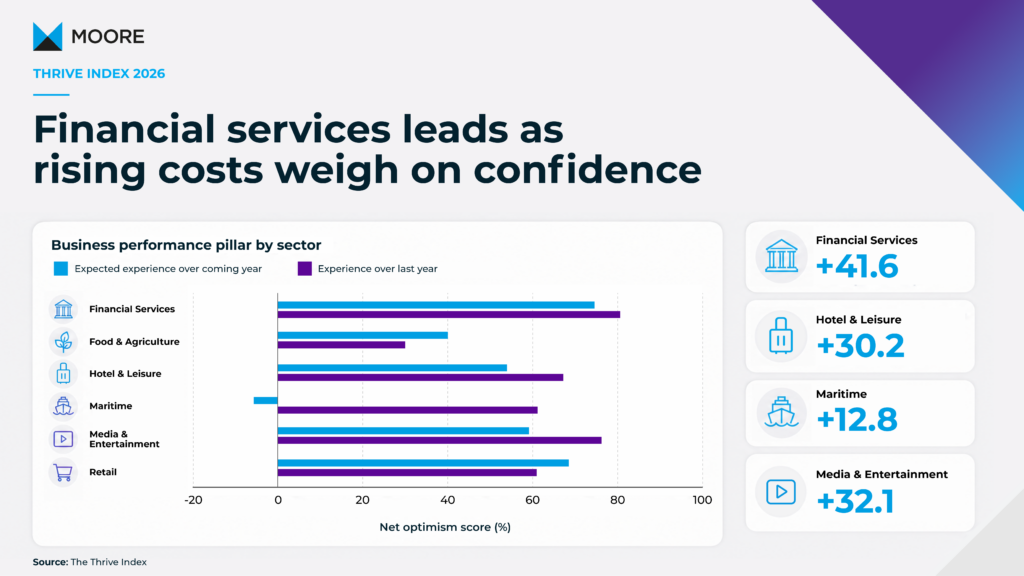
Strong revenue expectations are driving higher-than-average business confidence in financial services compared to other major global sectors where geopolitical tension and rising costs are weighing on sentiment.
The financial services sector achieved an overall score of +41.6 in the latest Moore Thrive Index, outstripping a global average of +35.1. Confidence is underpinned by strategic investment in AI and fintech platforms to improve efficiency and create growth opportunities.
Among six key sectors which are important to global growth and employment, media and entertainment stood out as a stronger-than-average performer last year. However, future growth expectations are tempered by worries that economic slowdown could reduce client budgets.
Hotel and leisure along with retail have proven resilient in the past year, performing only slightly below the global average.
Looking ahead, both are cautious on the labour market but retail is optimistic that productivity and efficiency will boost performance. It recorded a score of +67.7 on future business performance, higher than the global average.
Food and agriculture and maritime have been hardest hit by supply chain interruption linked to Middle East conflict and higher energy costs.
Food and farming companies are offsetting higher input costs by investing in digital tools to boost productivity but shipping companies expect geopolitical factors and costly changes to long-haul shipping routes to weigh on performance.
Moore’s Thrive Index is a bespoke research project that measures business sentiment and performance among mid-market companies from 17 international markets. It combines data and insight from 2,425 companies, capturing their experience in the past year and gauging their confidence in the future.
The Index calculates the balance of positive to negative scores on five core pillars: business sentiment, revenue, costs, the labour market and investment.
Financial services
Sector Index Score +41.6 … +6.5 v Global Average
Financial services firms achieved scores higher than the global average on four of the five core pillars of the Thrive Index: investment, the labour market, revenue and business performance.
The sector posted an overall Index score 6.5 points above the global average, slightly up on last year. It ranked below average on the single measure of future cost expectations, with two-thirds of firms expecting expenses to rise.
Factors influencing performance include interest rate movements and the cost of finance. Major global economies are entering a new phase, largely characterised by a gradual end to the extended cycle of monetary policy easing.
The sector continues to invest heavily in digital tools and AI to drive down costs, increase efficiency and reduce losses from fraudulent and criminal activity. Deploying innovative fintech to reshape the industry is a key contributor to confidence in the future.
Food & Agriculture
Sector Index Score +18.0 … -17.1 v Global Average
Rising input costs, particularly for fertiliser and energy, are major concerns for food and agricultural producers. They are also vulnerable to geopolitical and climate risk.
These factors jointly contributed to the sector recording an overall Index score significantly below the global average.
Fertiliser prices recently reached their highest level since 2022, impacted by conflict in the Middle East which has led to repeated closures and constraints in the Strait of Hormuz through which one-third of the world’s key fertiliser chemicals pass. Higher cost and lower availability of fertiliser could limit agricultural output.
Now, the sector is dealing with El Niño, a climate pattern which causes extreme weather and can lead to drought in some regions and flooding in others, affecting crop production.
While its 2026 Index score is low, the sector’s broadly positive outlook on future business performance is explained by supportive underlying demand and investment to boost productivity.
Hotel & Leisure
Sector Index Score +30.2 … -4.9 v Global Average
Hotel and leisure companies anticipate a more challenging year ahead amid concerns that emerging inflationary pressure could dampen consumer spending. The uncertainty has led to more cautious views on the labour market, investment plans and revenue expectations.
The sector’s total Index score is only slightly below the global average but there are clear signs of an expected hiring slowdown.
The report shows a swing in sentiment on employment from more positive than average last year to just +18.8 for the current year. That is substantially below the global average of +36.3.
After a year of brisk investment, which exceeded the global average, firms plan lower levels of spending in the current year.
The sector has made major strides in recent years towards transforming its cost base and improving guest experiences through intelligent use of AI, real-time data and diverse technology solutions including property management systems, dynamic room pricing and robot waiters.
Maritime
Sector Index Score +12.8 … -22.3 v Global Average
The maritime sector was caught in the eye of the geopolitical storm as conflict in the Middle East severely disrupted shipping routes and energy supply. This has made transporting raw materials and manufactured goods around the world more risky, complex and costly.
The shipping industry carries 80% of global trade and has had an exceptionally difficult year. It has been severely impacted by repeated closure of the Strait of Hormuz, a major global trade artery that transports large shipments of crude oil, gas and fertiliser.
It recorded the lowest overall Index score of +12.8 and the outlook continues to be subdued. The World Trade Organisation (WTO) forecasts that growth in global goods trade will slow to 1.9% in 2026 from 4.6% in 2025.
Higher energy prices are inflating operating costs and putting pressure on margins as rerouting ships involves longer journey times and increased fuel consumption.
Media & Entertainment
Sector Index Score +32.1 … -3.0 v Global Average
Media and entertainment businesses are transitioning from stronger-than-global average performance last year into a more cautious period.
Companies are alert to the twin possibilities of weaker business confidence reducing marketing and advertising budgets and weaker consumer confidence cutting leisure spending.
Advertising and marketing spend have held up well. This was achieved despite grappling with cost pressures from rising wage bills and raw materials to logistics and financing costs. At least some of those headwinds are expected to ease in the current year.
Digital innovation is moving at a rapid pace in the sector, with advances in AI revolutionising working practices. Companies are now looking to move up the value chain, capitalising on rising customer demand for marketing and commercial strategy as well as production services.
Retail
Sector Index Score +29.2 … -5.9 v Global Average
Around one-third of retail business leaders say productivity gains and efficiency improvements are the key factors in delivering better performance in the year ahead.
Inflation trends are critical for retail, affecting consumers’ buying power and their ability to afford discretionary purchases. They also impact input costs from direct energy consumption to the cost of wholesale goods, manufacturing, transportation and wages.
A slight easing in global inflation benefited the retail sector as worldwide consumer price growth eased from pandemic peaks. However, the risk of renewed inflation remains, with some countries continuing to see price rises outpace wages growth, keeping household shopping budgets tight.
Just under half of retail businesses increased staff last year, while a net balance of businesses indicated they would find it more difficult to afford staff costs in the coming year.