







African LNG — Europe’s Strategic Energy Lifeline
Nigeria holds the ninth‑largest gas reserves in the world yet imports most of its LPG. Europe has lost an estimated 20% of its LNG supply following the closure of the Strait of Hormuz. These are not separate challenges.
They reflect the same underlying issue: Africa’s gas reserves are well established, but the structures required to bring that gas to market efficiently have not kept pace. Addressing that gap matters on both sides — for African producers and for European buyers.
The temporary closure of the Strait of Hormuz in early March 2026 triggered the largest single supply disruption the global oil and gas market has seen. Floating LNG developments along Africa’s Atlantic coast have moved to the centre of attention as a result. Turning that potential into delivered volumes depends less on geology than on how projects are structured.
Geographic advantage is structural
LNG exports from Nigeria, Senegal, Mauritania, Gabon and the Republic of Congo avoid both the Strait of Hormuz and the Red Sea. That reduces shipping risk, shortens sailing times to European terminals, and removes two of the most exposed chokepoints in global gas trade.
This advantage predates the current disruption. What has changed is how buyers view it. Before 2026, Atlantic supply was one option among many. Following the loss of Qatari deliveries – which had accounted for roughly 16 million tonnes per year of European supply – diversification away from those routes has become a lasting procurement objective.
African projects are well placed to respond. The more difficult question is whether they can do so within a timeframe that still matters to the market.
Why African LNG projects keep stalling
The pattern is familiar. Mozambique LNG was suspended for more than four years following security disruptions in Cabo Delgado. Tanzania LNG has spent over a decade in active discussion without reaching Final Investment Decision. In both cases, the underlying issue has been structural rather than geological.
Large onshore LNG projects concentrate technical, political, security and commercial risk into a single decision point. They then require a wide group of stakeholders, each with different risk tolerances, to commit simultaneously. When one participant hesitates, progress stalls.
The gas itself is rarely the constraint. The way risk is packaged and presented to capital is.
For a broader assessment of how country‑level risk influences investment decisions in Mozambique, Tanzania and Nigeria, see our upstream investment outlook for 2026.
For a broader assessment of how country level risk influences investment decisions in Mozambique, Tanzania and Nigeria, see our upstream investment outlook for 2026.
How capital markets price this wrong
Capital markets often treat African LNG risk as binary: either a project clears the bar or it does not. Above‑ground, political and security risks tend to be assessed as fixed attributes of a jurisdiction, rather than variables that can be sequenced or reduced through design choices.
The result is a persistent mispricing. Gas resources that would attract financing readily in other regions remain undeveloped, not because the economics are unsound, but because the project structures presented do not align with available risk appetite.
A well‑designed floating LNG project on a proven block – with secured offtake, multilateral participation and a confirmed vessel – can reach first production within two to three years of Final Investment Decision. Projects relying on conversions of existing LNG carriers or modular units can meet that window. By contrast, large new‑build FLNG vessels typically require four to five years from sanction.
The distinction matters. Applying the risk framework of a USD 20 billion onshore terminal to a modular floating project leads to the wrong investment outcome.
The vessel constraint is a strategic variable
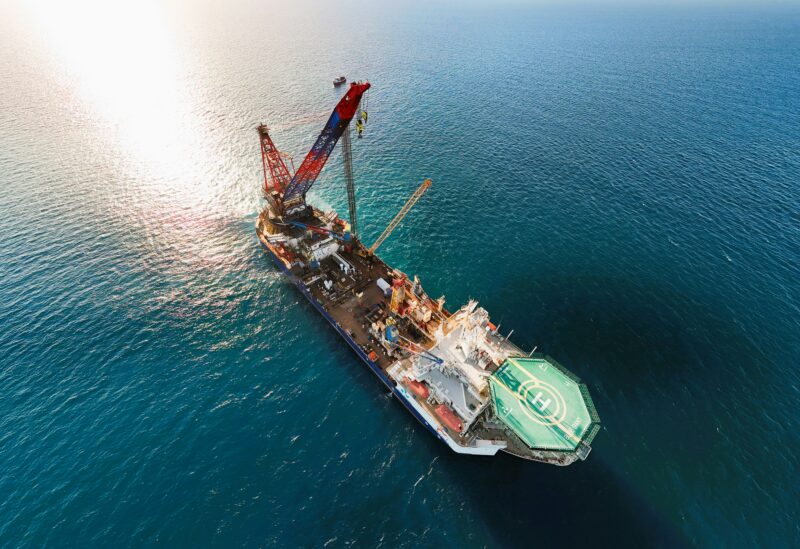
As of late 2025, eight floating LNG projects were operational worldwide, with nine additional units under construction. Against the volume of African gas under discussion, that is a limited pool of available capacity.
Vessel availability – whether through new builds, conversion of retiring Moss‑type carriers, or redeployment of uncommitted units – is now one of the primary constraints on how many projects can progress in parallel. Conversions offer the fastest fabrication routes and are becoming more viable as older carriers reach retirement.
For project sponsors, the implication is straightforward. Vessel strategy needs to sit at the front of the development process. Projects that secure tonnage early gain a timing advantage that is difficult to recover later, particularly as multiple developments compete for the same limited infrastructure.
FLNG is a market access strategy
Phased LNG development is most often framed as a financing tool: reduce upfront capital, manage risk, prove the reservoir before scaling. That logic holds. It does not capture the full picture.
A 1-2 million tonne per year floating LNG unit, sanctioned today on a proven field with secured offtake, can deliver cargoes into Europe while the current supply window remains open. A large onshore project initiated today cannot. By the time it reaches first gas, market conditions will have shifted and procurement portfolios will already have adapted.
Phased development allows African gas to enter the market when timing still carries value. Early phases generate cash flow, establish operational credibility and create the contract history that later phases rely on. For lenders and offtakers alike, that track record reduces uncertainty. Speed, rather than scale, becomes the differentiator.
Africa’s advantage is not the size of its reserves. It is that floating LNG, structured appropriately, can reach European markets faster than any large‑scale alternative currently available.
The alternatives cannot close the gap
Following the Hormuz disruption, US LNG terminals were operating at approximately 94% utilisation. Incremental supply growth depends on new capacity, which requires years to permit and build. Norway, producing around 355 million standard cubic metres per day in early 2026, was already satisfying close to 30% of combined EU and UK demand, with little spare capacity remaining.
Together, these sources anchored Europe’s diversification strategy after 2022. Both are now effectively constrained. Against that backdrop, African floating LNG presents a more credible near‑term solution. The geography is favourable, timelines are competitive, and the remaining barriers are largely procedural rather than technical.
See our upstream investment outlook for 2026 for a full breakdown of Africa’s capital pipeline and regulatory environment.
Three projects that have already proved the model
Congo LNG, Republic of Congo
Eni’s first floating LNG unit came online in early 2024, with a second following in late 2025. Financing for phase two progressed more smoothly, reflecting the operational track record established by phase one.
Coral South FLNG, Mozambique
By April 2025, Coral South had shipped its 100th cargo. That performance underpinned the African Development Bank’s senior loan for the Coral Norte follow‑on project, with commercial lenders subsequently participating on improved terms.
Greater Tortue Ahmeyim, Mauritania and Senegal
The project achieved first gas at the end of 2024 and began commercial exports in mid‑2025. With infrastructure and shipping routes established, phase two has entered pre‑Final Investment Decision development.
Projects that stall tend to share one characteristic: they attempt to start at scale.
Policy is the remaining barrier
Fiscal regimes designed for large onshore LNG projects can unintentionally disadvantage modular floating developments. Applying a framework calibrated for a 12 million tonne terminal to a 1.5 million tonne FLNG project inflates costs and misaligns risk.
Nigeria, Mozambique, Senegal and the Republic of Congo are all moving in the right direction. The practical step that matters most is clarity. Publishing project‑specific fiscal terms for floating LNG before licensing rounds open allows investors to structure financing and offtake with confidence.
For governments sitting on reserves that European buyers now urgently need, this is the most direct lever available. Define the terms at the right scale. Capital that already understands the opportunity will respond.
To explore the implications of Africa’s evolving gas market for your business, investment strategy or project pipeline, contact Moore’s Energy and Mining team.
"*" indicates required fields